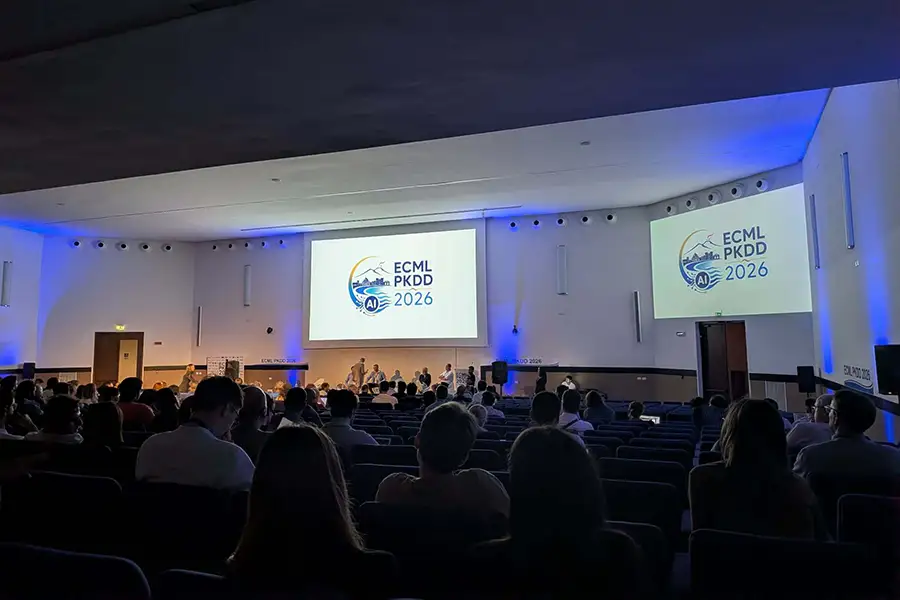
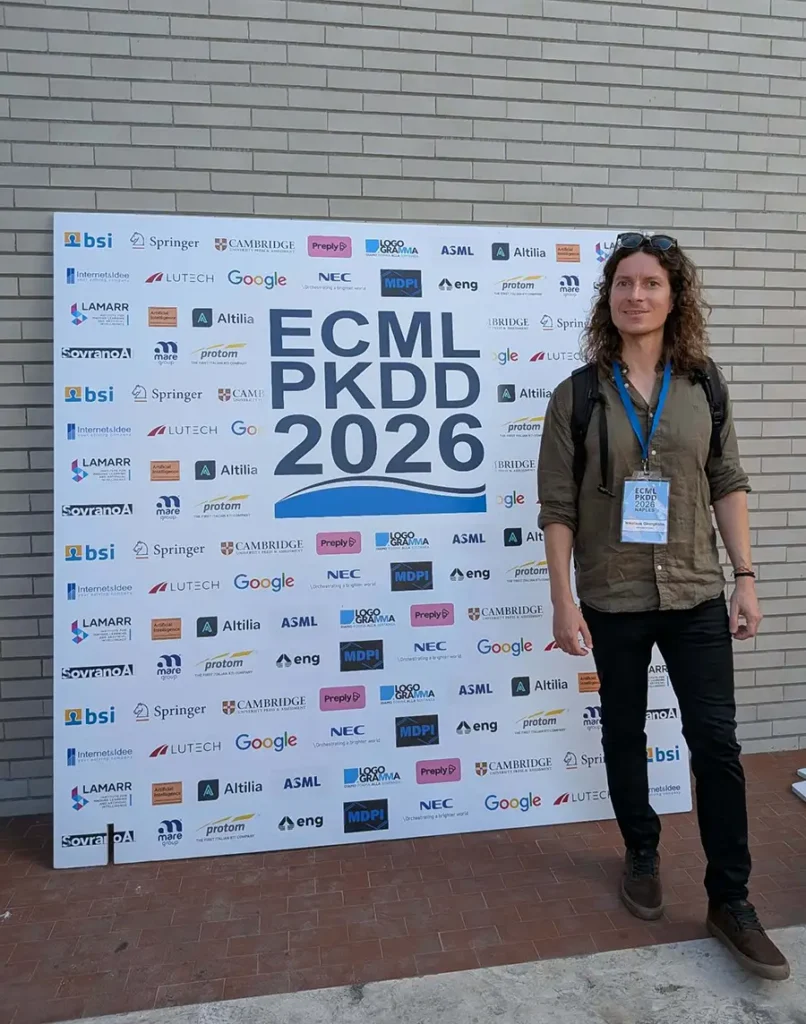
ETIA researcher Nikolaos Gkorgkolis, PhD, presented new work on Large Causal Models for Temporal Causal Discovery at ECML PKDD 2026, held in Naples, Italy, from 7–11 September.
The paper, published in the conference’s Research Track proceedings, was co-authored by Nikolaos Kougioulis, Nikolaos Gkorgkolis, MingXue Wang, Bora Caglayan, Dario Simionato, Andrea Tonon and Ioannis Tsamardinos. The research brings together teams from the Institute of Applied and Computational Mathematics at FORTH, the Computer Science Department of the University of Crete, and the Huawei Ireland Research Centre.
ECML PKDD is one of Europe’s leading conferences in machine learning and knowledge discovery, bringing together researchers working across areas including causal discovery, foundation models, time series, trustworthy AI and data-centric learning. The 2026 edition featured peer-reviewed research presentations, invited talks, workshops, tutorials and poster sessions.
From one model per dataset to reusable causal models
Traditional causal discovery methods often work on a dataset-by-dataset basis: a new model must be fitted each time researchers want to recover the underlying causal structure of a new dataset.
The work presented at ECML PKDD explores a different direction.
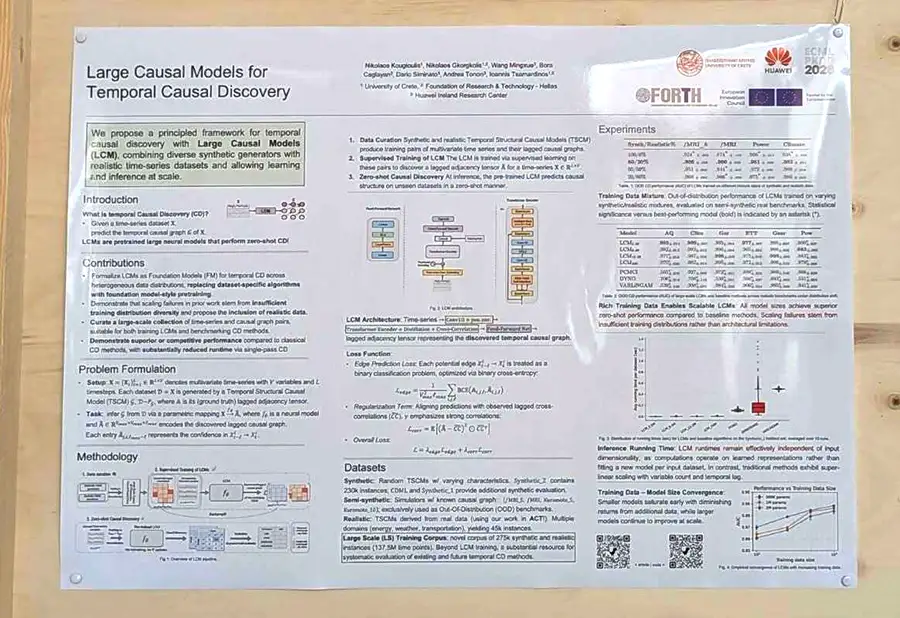
The researchers propose Large Causal Models (LCMs), pretrained neural architectures designed specifically for temporal causal discovery. Rather than starting from scratch for every dataset, the aim is to train models across large and diverse collections of time-series data so that they can later infer causal structure rapidly on unseen data.
The framework combines synthetic causal data with realistic time-series datasets and was evaluated across synthetic, semi-synthetic and real-world benchmarks. According to the published results, the models scale to larger numbers of variables and deeper architectures while maintaining strong performance, and can perform fast, single-pass inference on new datasets.
In practical terms, this moves causal discovery closer to the broader foundation-model paradigm already transforming other areas of AI: train once across many examples, then transfer that learned structure to new problems.
Why this matters for ETIA
The research is closely aligned with ETIA’s broader goal of making causal discovery more scalable, robust and practical.
ETIA is developing automated tools for discovering causal relationships, reasoning over them and applying them to real-world scientific and industrial problems. Large Causal Models represent one possible route toward faster and more transferable causal analysis, particularly for complex temporal data.
The paper also has a direct connection to the ETIA project itself: its acknowledgements state that the work was funded by the European Union under EIC Transition project 101291665, the ETIA grant.
Nikos presented the work at ECML PKDD 2026 alongside a research poster outlining the model architecture, training strategy, experimental results and evaluation across multiple datasets.
Open research and reproducibility
The research team has also made the implementation and pretrained models available online, allowing other researchers to reproduce experiments and explore the approach further. The public repository includes model checkpoints, benchmark datasets and code for running inference.
The wider FORTH–Huawei research collaboration also provides an accessible overview of the Large Causal Model approach, including examples of how time-series data are converted into causal graphs and how the resulting models can be used for rapid causal discovery.
Read more
Read the paper on Springer Nature
View the ECML PKDD 2026 conference site