The launch of ETIA: Causal AI for Data-Driven Insights and Optimal Decision Making has attracted attention from local media in Crete, with several publications highlighting the project’s €2.5 million EIC Transition funding, its focus on causal artificial intelligence, and its path from university research toward real-world application.
On 29 September, HANIA.news published the article “University of Crete: Funding for the ETIA causal artificial intelligence project”, reporting on the €2.5 million secured through the European Innovation Council’s EIC Transition programme. The article notes that €500,000 of the total funding will benefit the University of Crete and describes ETIA as a project designed to automate knowledge discovery and decision support from data.
The same day, IraklioNews featured ETIA under the headline “University of Crete: €2.5 million funding for pioneering Artificial Intelligence project – New company on the way.” Its coverage focused not only on the technology itself, but also on the project’s commercialisation pathway, including plans for a new University of Crete spin-off company. The article also highlighted ETIA’s ambition to move beyond predictive modelling by identifying causal relationships in data, with potential applications across industry, science and medicine.
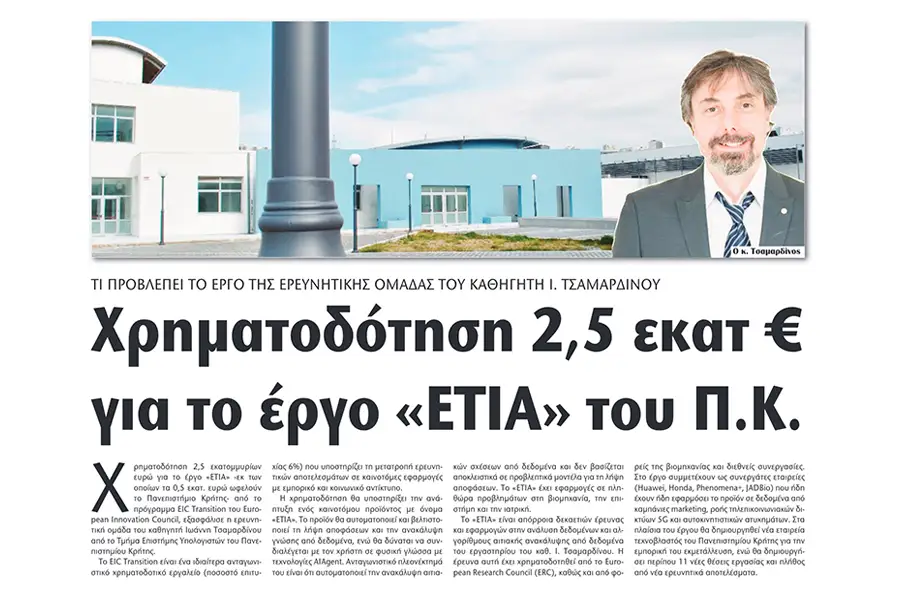
ETIA was also featured in the local press (ΠΑΤΡΙΣ) with the headline “€2.5 million funding for the ETIA project of the University of Crete.” The print article presented the project as the latest stage in the research led by Prof. Ioannis Tsamardinos and his team, focusing on automated causal discovery and the development of an AI system capable of supporting data-driven decisions while interacting with users through natural language.
Across the coverage, several themes stood out.
One was the highly competitive nature of the EIC Transition programme, which is designed to help move promising research results beyond the laboratory and towards technologies with commercial and societal potential. Both online publications reported a programme success rate of around 6%.
Another was ETIA’s distinctive focus on causal AI. Rather than relying exclusively on predictive models, ETIA is being developed to automate the discovery of plausible causal relationships within data. The goal is to help users investigate not only what is likely to happen, but also which factors may be driving an outcome and how different decisions could influence it.
The reports also highlighted the research foundations behind the project. ETIA builds on years of work in data analysis and causal discovery at the University of Crete, supported previously through European Research Council funding and collaborations with industrial partners. Real-world applications already explored by the wider research team include telecommunications, marketing and automotive safety.
For ETIA, this early local coverage marks an important first step in communicating the project beyond the research community. As the project now moves into implementation, the aim is to continue sharing its scientific progress, technological development, collaborations and emerging applications with researchers, industry and the wider public.