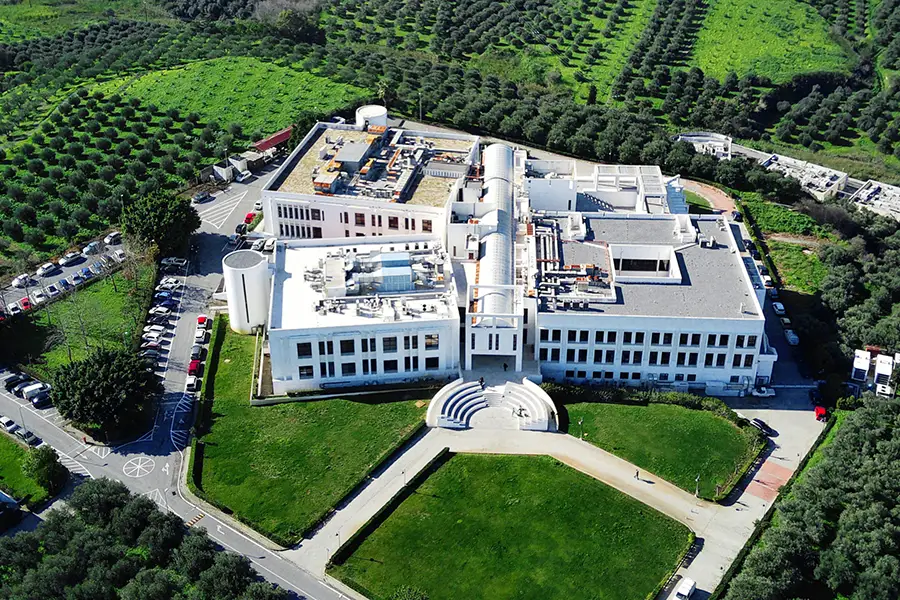
The ETIA team will take part in the 15th Scientific FORTH Retreat, beginning on Friday, 9 October 2026, with research on causal discovery represented through both a scientific poster and a presentation by Prof. Ioannis Tsamardinos.
The FORTH Scientific Retreat brings together researchers from across the Foundation for Research and Technology-Hellas to share current work, exchange ideas across disciplines and explore new directions for collaboration. This year’s programme also includes the 2026 Kafatos Lecture by Nobel laureate Svante Pääbo, which FORTH describes as part of the 15th Scientific Retreat.
Large Causal Models on the poster programme
ETIA participant Giannis Mamakas, will present the team’s work on “Large Causal Models for Temporal Causal Discovery”, research developed by Nikos Gkorgkolis, Nikolaos Kougioulis, MinXue Wang, Bora Caglayan, Dario Simionato, Andrea Tonon and Ioannis Tsamardinos, with affiliations spanning FORTH, the University of Crete and Huawei Ireland Research Centre.
The work explores a different approach to a longstanding challenge in causal discovery. Traditionally, a new causal model is fitted separately for each dataset. The Large Causal Models, or LCMs, framework instead investigates whether pretrained neural models can learn across many time-series datasets and then identify causal structure in previously unseen data.
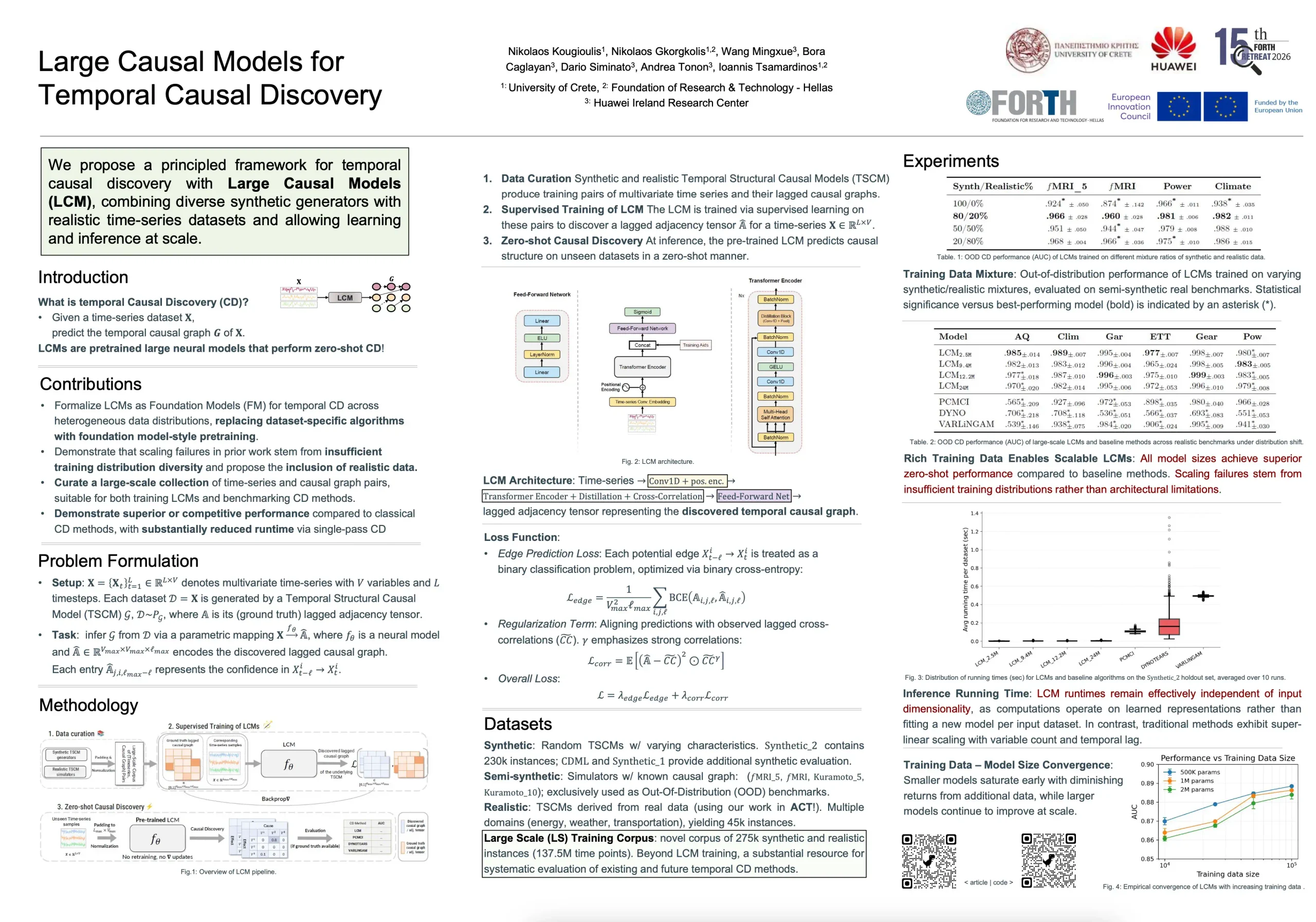
The research combines diverse synthetic generators with realistic time-series datasets and evaluates the resulting models across synthetic, semi-synthetic and realistic benchmarks. The results point to LCMs as a promising foundation-model approach for temporal causal discovery, with fast single-pass inference and competitive or superior performance in a number of out-of-distribution settings.
The scientific poster gives Retreat participants a visual overview of the approach, from the construction of the training data and model architecture through to zero-shot causal discovery and experimental results. It also highlights a large-scale training corpus containing 275,000 synthetic and realistic instances, designed not only for LCM development but also as a resource for evaluating temporal causal discovery methods.
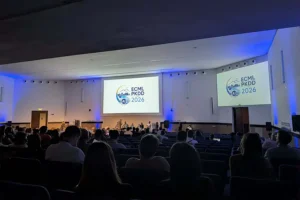
The work was recently presented at ECML PKDD 2026, extending its journey from an international machine-learning conference to the wider scientific community at FORTH.
From prediction to causality
On Sunday, Prof. Ioannis Tsamardinos, ETIA Project Coordinator, will speak on “Automated Machine Learning and Causal Discovery for Biomarker and Knowledge Discovery.”
His presentation will look at the team’s work in Automated Machine Learning, including the automatic construction of predictive, diagnostic and prognostic models, particularly for challenging molecular datasets where the number of measured variables can be very large compared with the number of available samples. One important application is the discovery of biomarkers associated with disease, treatment response or disease subtypes.
The talk will then move from prediction to causality, introducing the team’s more recent work in Automated Causal Discovery. Rather than only estimating what is likely to happen, causal models are intended to support questions such as what could happen under a different action, which decisions may influence an outcome, and what might have happened under alternative circumstances.
That transition sits at the heart of ETIA’s research programme: making sophisticated causal discovery and reasoning increasingly automated, scalable and accessible for scientific and real-world applications.
For ETIA, the FORTH Retreat offers an opportunity to present this work within the broader research community from which much of the project’s scientific foundation has emerged, while opening the conversation to researchers working across very different disciplines.